
Oklahoma Resident Lookup Records by Type
Oklahoma has no single record that answers every identity question. Start with the record most likely to confirm the point being checked, then compare an independent source and its date. An owner record is not a list of everyone at an address; a court result may identify a party, not a current resident. This coverage table separates those uses and their access paths.
| Record | What It Can Confirm | Where | Access |
|---|---|---|---|
| Assessor parcel | Owner, parcel situs, billing address, legal description | County assessor | Usually free online; phone or counter fallback |
| Recorded deed | Transfer parties, date, legal description | County Clerk or Recorder | Portal, terminal, or copy request; rules vary |
| OSCN court index | Case number, party role, type, dates, docket events | Oklahoma State Courts Network | Online index; clerk for older files and copies |
| OK2Explore | Eligible birth or death index event and county | OSDH Vital Records | Free index; certificates have separate rules |
| Voter tools | A person’s own registration and districts | OK Voter Portal and EDW | Name and DOB for personal check; file access restricted |
| Business and license records | Public entity or professional affiliation | Secretary of State or relevant board | Search availability and fields vary |
| Historical indexes | Older family, address, probate, or obituary clues | OHS and public libraries | Catalog, onsite, research request, or licensed terminal |
If the question is whether two records refer to the same person, keep the name spelling, county, date range, and any corroborating address together. A search result is a lead to the custodian’s record, not a finding about a person by itself.
OSCN Fields in an Oklahoma Resident Lookup
The Oklahoma State Courts Network (OSCN) lets a searcher choose a participating county or court and search by party, case number, lower-court number, or district-court traffic citation. Its visible fields allow name and date filters, but coverage dates are not stated and participating courts differ. The citation mode is for district court only; the page says it does not search municipal citations.
OSCN’s case-search page shows the court and party controls. The field inventory below follows that live form; values in dropdowns may load dynamically.
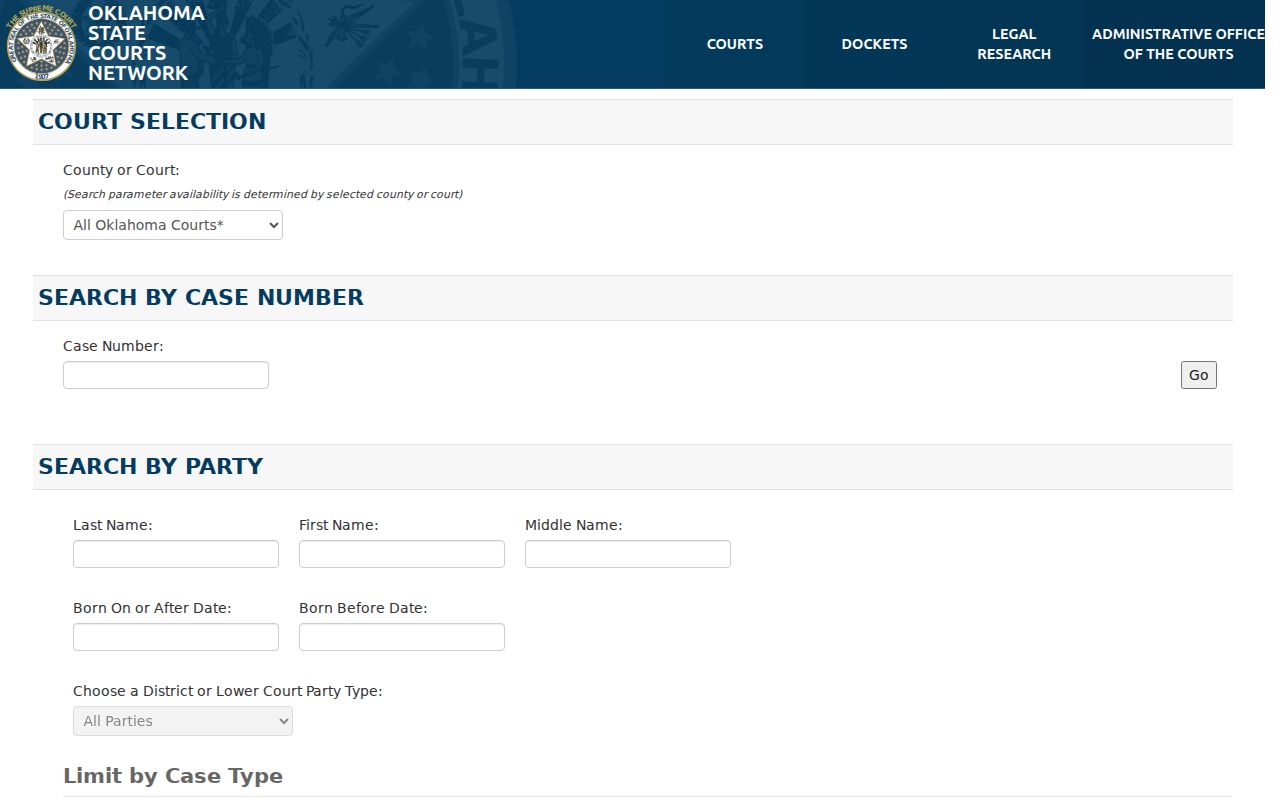
Use a known county or court and narrow by date when a name is common. If the online result lacks a filing, the local Court Clerk is the route for a public terminal, older archived file, certified copy, or material that is not shown online. The municipal court for the city involved is separate from OSCN’s district-court search.
| Field Label | Type | Required | Options or Format Notes |
|---|---|---|---|
| County or Court | Dropdown | Not stated | Select a participating county or court |
| Case Number | Two text inputs | No | Case-number search mode |
| Last Name | Text | No | Party-name search mode |
| First Name | Text | No | Party name |
| Middle Name | Text | No | Party name |
| Born On or After Date | Date or text | No | Birth-date range filter |
| Born Before Date | Date or text | No | Birth-date range filter |
| District or Lower Court Party Type | Dropdown | No | Options load dynamically |
| Appellate Court Case Type | Dropdown | No | Appellate category; options load dynamically |
| District Court Case Type | Dropdown | No | District category; options load dynamically |
| Cases Filed After/Before Date | Date pair | No | Filing date range |
| Cases Closed After/Before Date | Date pair | No | Closing date range |
| Lower Court Court | Dropdown | No | Appellate-only lower-court number mode |
| Lower Court Case Type | Dropdown | No | Appellate-only |
| Filing Year | Text | No | Appellate lower-court number mode |
| Number | Text | No | Lower-court number mode |
| Citation Number | Text | No | District traffic search; municipal citations are not searched |
A sample docket inventory should preserve the fields that identify a result:
- Case number, county or court, case type, and filing date.
- Party names and roles, with attorney or other party entries if shown.
- Case status, disposition, or closed date.
- Docket-event dates and text, and a citation number when applicable.
- Links to filings that the public result makes available.
One result can name a plaintiff, defendant, attorney, or creditor; it does not prove a current address. Sealed, expunged, juvenile, adoption, and confidential family-law material may be absent or redacted.
- Docket
- The dated list of events and filings tied to a court case.
- Index vs. image
- An index helps find a record; an image is a view of a document, when the custodian makes it available.
- Certified copy
- A copy issued and authenticated by the record custodian under its copy rules.
Oklahoma Resident Records in Vital Indexes
OK2Explore is a free index search, separate from an order for a birth or death certificate. Its fields are event type, event date, county, subject name, and subject sex. The index covers births at least 20 years old and deaths at least 5 years old. A hit shows that an event record is on file; it does not waive proof-of-identity or eligibility rules for a copy.
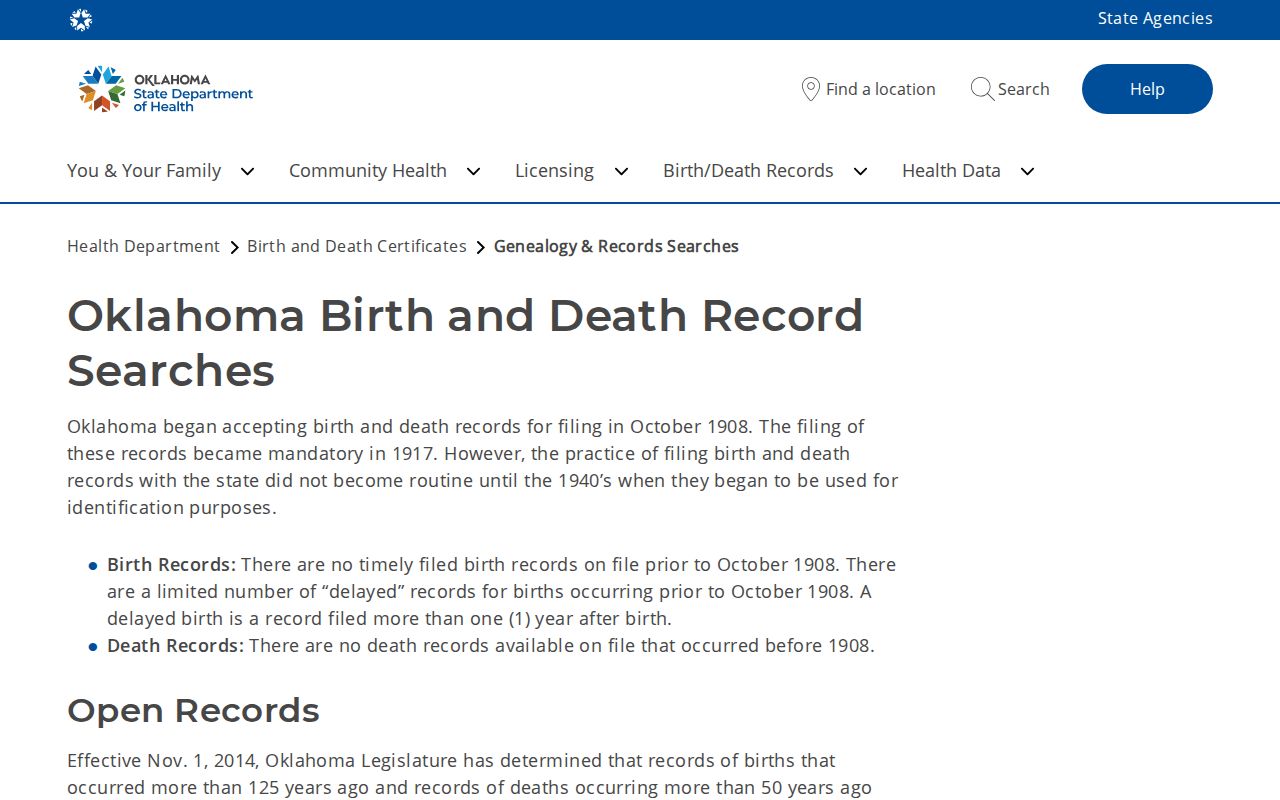
OSDH explains the open and closed record rules for Oklahoma vital records, including the index’s age thresholds.
The OK2Explore search form separates event type and date from county and name details. Test name variants and the county of the event when known, then save the result details before contacting the custodian.
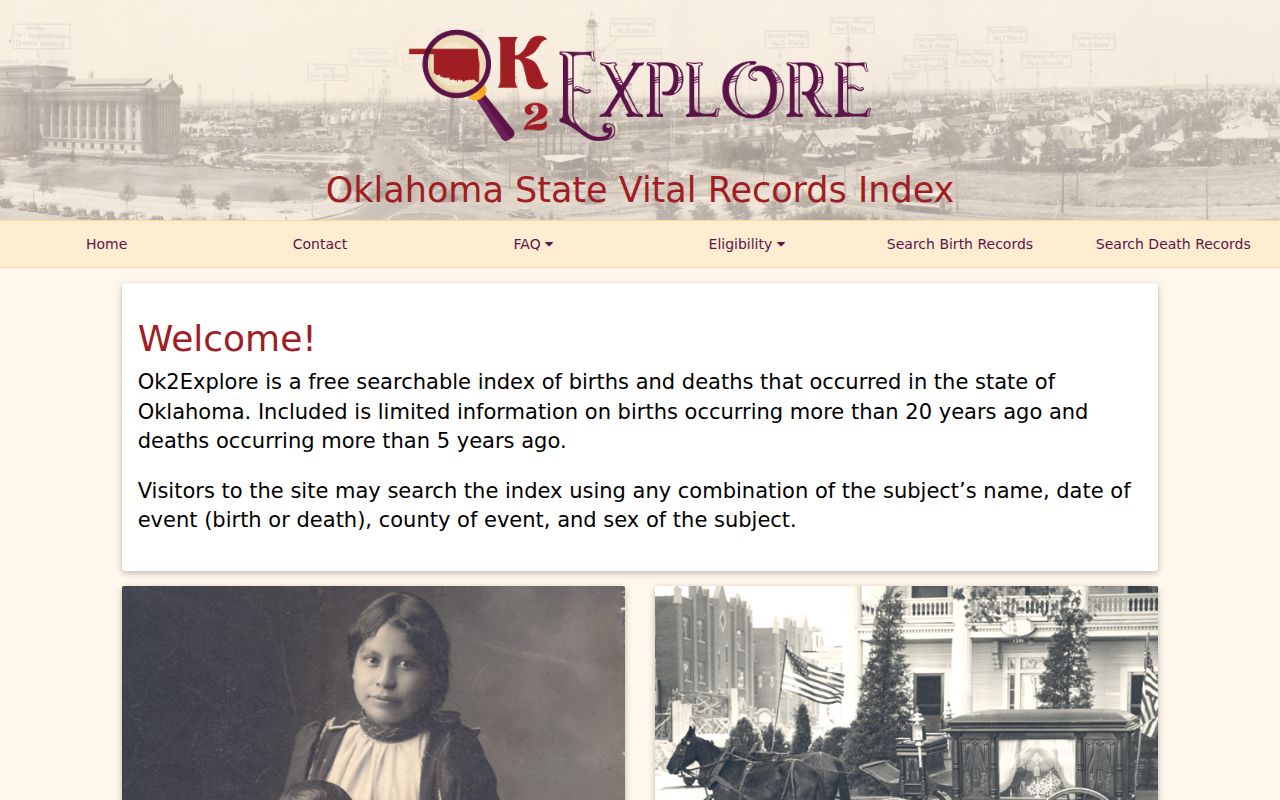
The fields show the event, date, county, name, and sex when applicable. Save those details and use the correct county or custodian for the next step.
Oklahoma Resident Records and Vital Copy Rules
Oklahoma began accepting birth and death filings in October 1908; birth filing became mandatory in 1917, and routine state filing became common in the 1940s. The state file has no timely filed births before October 1908 and no death records before 1908. Earlier family research may need county marriage registers, church records, cemetery or funeral-home sources, newspapers, or delayed registrations.
Open copies are available after 125 years for births and 50 years for deaths. Other copies require an eligible requester, authorization, legal relationship or representation, court order, or another statutory route; sealed adoption birth records require a certified court order. OSDH lists a non-refundable $15 search fee per record and $15 for each additional copy. A completed application, valid photo ID, fees, and eligibility proof are required when applicable.
- Birth copies are open after 125 years; earlier copies require an eligible route, and sealed adoption birth records need a certified court order.
- Death copies are open after 50 years; earlier copies require proof of familial or legal eligibility.
- Marriage records are held by the county clerk where the license issued; no single statewide public index was located.
- Divorce records are with the district clerk; OHS lists Oklahoma County divorce records for 1923–1944.
OSDH’s current vital-record forms page is the application starting point. The service lists online, phone, and mail search routes; do not assume a fax or another delivery method unless the current form says so. Vital Records Service is at PO Box 248964, Oklahoma City, OK 73124-8964, phone (405) 426-8880, email AskVR@health.ok.gov.
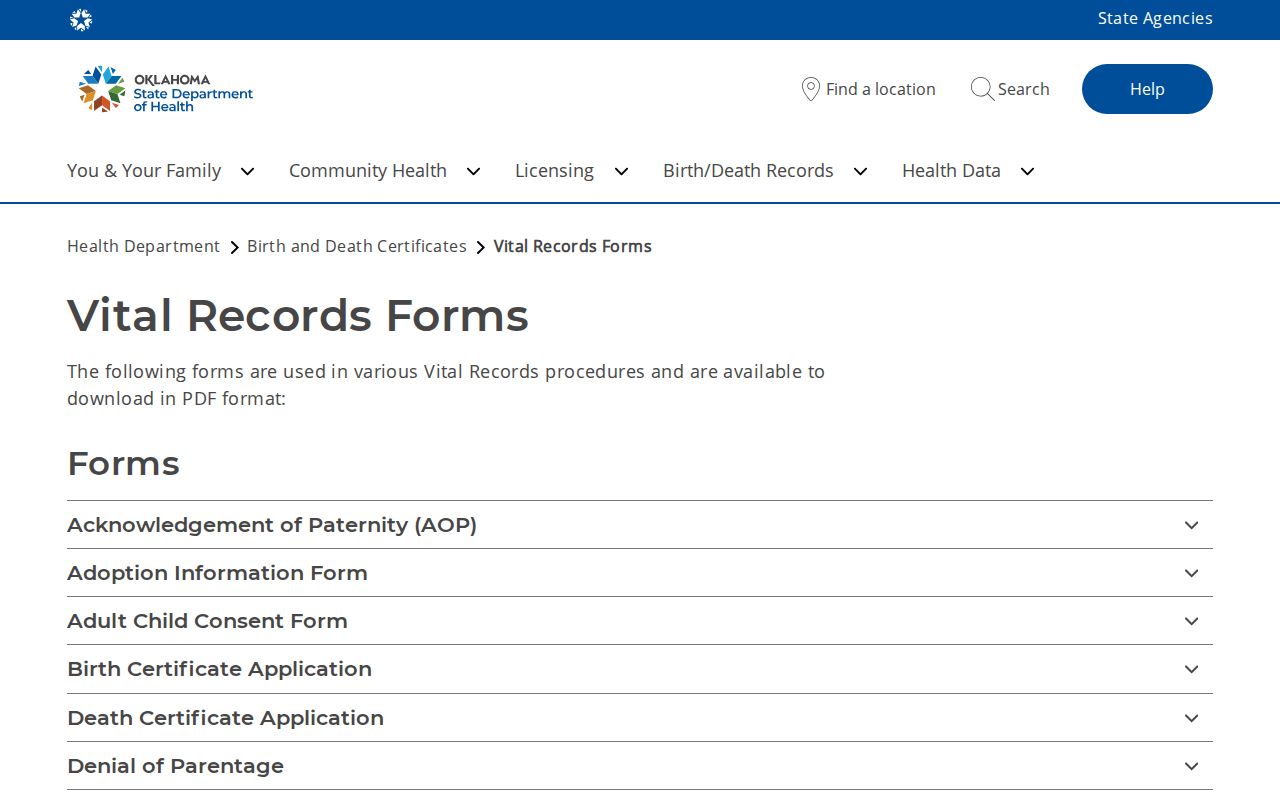
The application begins a formal order. An index result can guide family research, but it does not remove the certificate’s eligibility rules.
Oklahoma Voter Records and Resident Verification
The OK Voter Portal is for a voter to check their own registration, districts, polling place, absentee ballot options, and related services. It asks for the name as it appears on the registration and date of birth; some tasks need extra verification. It is not an unrestricted name or street browse.
The State Election Board’s EDW page explains full and basic access. Since November 1, 2025, full voter-list access is limited to qualified Oklahoma resident U.S. citizens, recognized party representatives, Oklahoma candidates or representatives, and others authorized by law. A full-access applicant uses the voter-list form; basic access has a separate form. The page directs submissions to info@elections.ok.gov.
| Lookup or Control | Type | Required | Options or Notes |
|---|---|---|---|
| Registered name | Text | Yes for OK Voter Portal | Must match the registration; exact format is not stated beyond “as it appears” |
| Date of birth | Date | Yes for OK Voter Portal | Additional verification may apply |
| Full EDW access request | Form | Conditional | 26 O.S. §7-103.2 eligibility; includes the full voter registration list |
| Basic EDW access request | Form | Conditional | No registration list; other data can include precincts, absentee requests, and deleted voters |
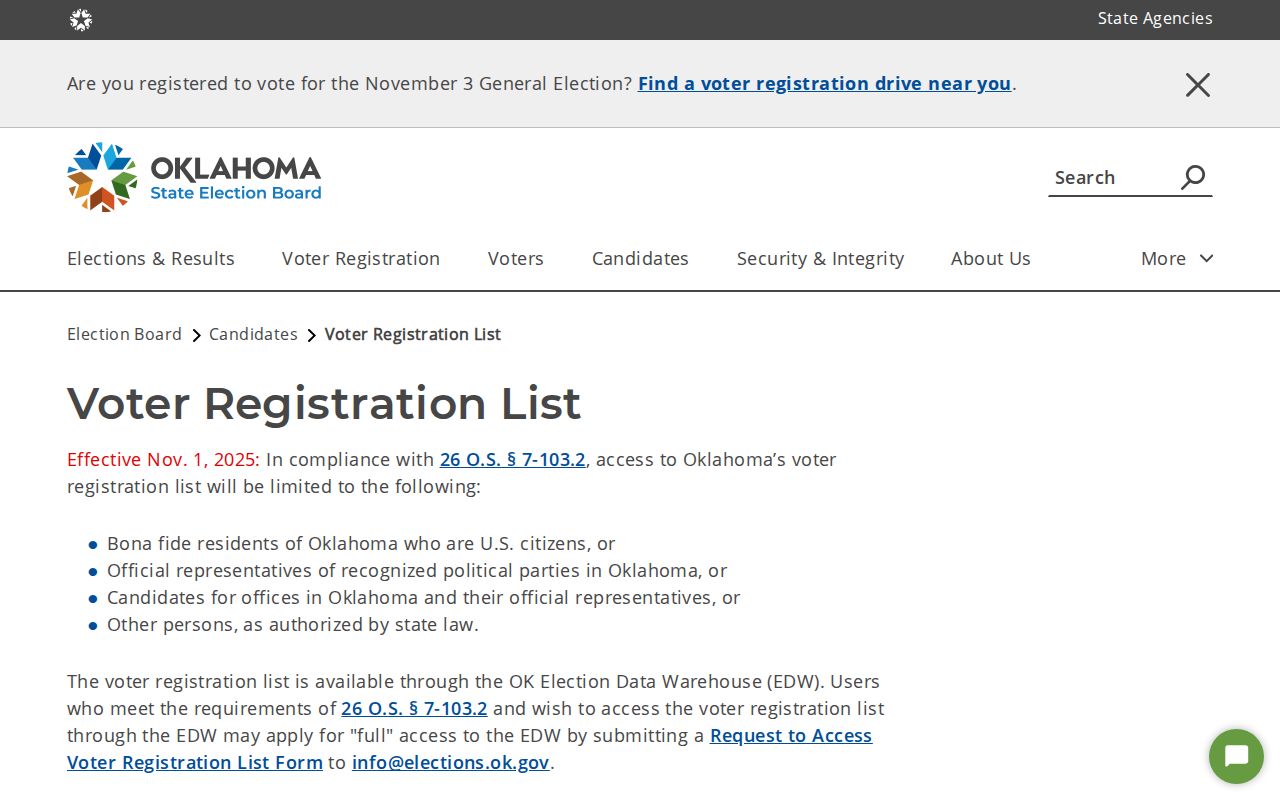
Approved EDW files are downloadable CSVs refreshed each weeknight and must be imported into the user’s own software. The Election Board says it cannot produce lists or labels directly and offers no technical support. Full-file fields may include name, an unprotected residence or mailing address, county or precinct, party affiliation, registration status or date, districts, and lawful participation fields; exact CSV columns were not confirmed. The file excludes Social Security and driver-license numbers; phone and email are not registration fields, and restricted or Address Confidentiality Program addresses are omitted. A voter record does not show ballot choices or prove that every person at an address is registered.
For a historical voter trail, check the county election board, OHS, the Oklahoma Department of Libraries State Archives, and local library for poll books or registration records. Exact historical year coverage varies and no statewide year table was located. County office phone and hours differ, so use the Election Board’s county directory for the address in question.
Business and License Clues in an Oklahoma Resident Lookup
The Oklahoma Secretary of State’s Business Entities Search begins with a required Entity Name and offers an Advanced Search control. A detailed filing is reached by its linked filing number and can show entity, registered-agent, officer, address, and filing-history information depending on the document. That is an affiliation clue, not proof of a person’s home or current role.
Professional status belongs to the relevant state board. Medical, nursing, dental, pharmacy, teaching, legal, real-estate, and other license searches have separate custodians and public fields. County assumed-name filings and city business licenses remain local. Use the exact board or clerk that maintains the record and treat only its published fields as confirmed.
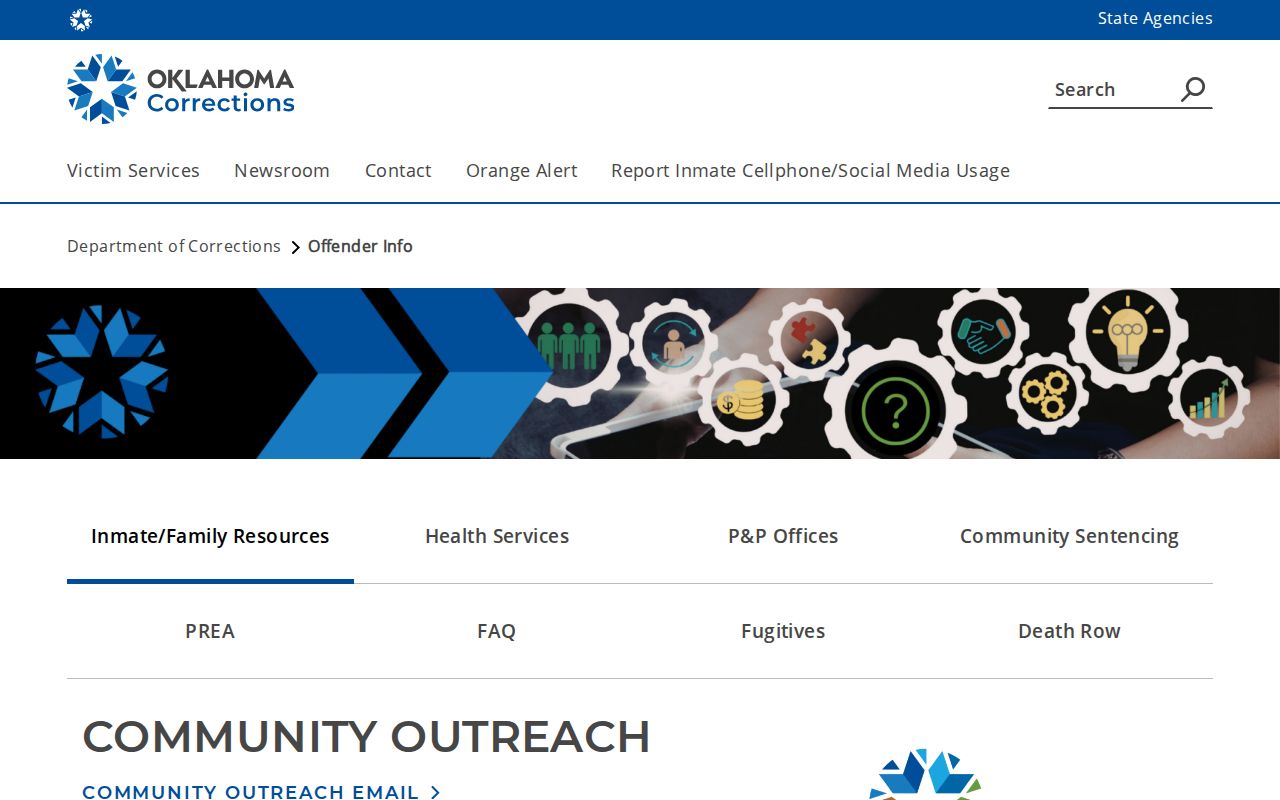
For custody questions, the Oklahoma Department of Corrections links to an official offender lookup. Its page explains that some closed records can be requested under the Open Records Act, while release dates are confidential unless the requester has a legitimate need and medical information is confidential unless the person authorizes release.
ODOC’s offender-information page links to the official lookup and request details. It can answer a custody-related question, but a corrections result is not a general list of current residents.
If no online index is available, contact the office that created the record, ask about a public counter terminal or copy request, and use a written records request when appropriate. Oklahoma’s Open Records Act covers identifiable existing records; it does not require an agency to create a custom report or reorganize information it does not maintain.
Oklahoma Family Records for Heirs and Classmates
A family search works best when the record path fits the relationship. For an heir, begin with a probate docket or will and then compare deed transfers and obituaries; court papers may name heirs, but sealed or sensitive details can be withheld. For a birth-parent search, first read OSDH’s closed-record rules and use the official adoption registry or confidential-intermediary process where applicable. Adoption birth records remain sealed without a certified court order.
A former classmate may be easier to trace through yearbooks, school collections, newspapers, and a library reference desk than through a present-day roll. OHS’s genealogy holdings include obituary, probate, marriage, directory, telephone, tribal, military, school, and newspaper resources. Named examples include Oklahoma County probate records for 1890–1928, Oklahoman obituaries for 1972–2014, Oklahoma City deaths for 1908–1926, and funeral-home records or programs for 1905–2020.
When a historical directory is the next step, the Oklahoma city directory collections explain how to locate a volume and read its date-specific entry. Use the local library for microfilm, interlibrary loan, or licensed databases, and contact OHS for its catalog, reference, or copy-order route.
Build a Two-Fact Match for One Oklahoma Resident
Common names need more than one matching fact. Preserve middle initials, suffixes, spouse names, age or event range, county, and address history. A parcel record may name an owner, a voter record a registered person, and a court record a party from another county. None automatically means the records describe the same individual.
- Write down the name as it appears, plus a known town, county, or approximate date range.
- Check the source suited to the question: property for an owner and parcel, OSCN for a court party, or OK2Explore for an eligible birth or death index event.
- Compare a second source for a consistent date, county, spouse, address, legal description, or event.
- Keep conflicts in a dated table instead of combining same-name results.
- Ask the custodian about record type and indexing conventions, then request a copy through its official process if needed.
For a record request under 51 O.S. §§24A.1–24A.31, identify the record, give a broad creation or transmission period, and use specific search terms. A public body may charge reasonable direct copying costs and can ask for advance payment when the estimate exceeds $75 or prior fees remain unpaid. That threshold and the Election Board’s example schedule are not a universal fee quote for every custodian.
Privacy Limits on an Oklahoma Resident Lookup
Oklahoma records have different access rules. Vital records follow 63 O.S. §1-323; voter lists are limited by 26 O.S. §7-103.2, and protected addresses by §4-115.2. The Address Confidentiality Program under 22 O.S. §60.14 creates a real break in the usual address trail. The Oklahoma Statutes database provides the text of these rules. Motor-vehicle data, utility customers, juvenile matters, sealed cases, and other protected details are not open resident indexes.
Do not try to infer an Address Confidentiality Program participant’s location from nearby parcels or other records. Correct an error with the office that owns the record: the assessor for a parcel, county clerk for a deed, Court Clerk for a docket, election board for voter data, or OSDH for a vital record. A commercial profile removal does not change the official source.
Lawful use. Use Oklahoma public records for a lawful personal purpose. Do not use names or addresses to stalk, threaten, harass, impersonate, or harm anyone; Oklahoma’s anti-stalking law is 21 O.S. §1173.