
Find Residents Across Oklahoma
Oklahoma has no master resident roll. Each record answers a narrower question, and each county or agency keeps its own part of the trail. A parcel card can name an owner; a voter service can help a registered voter check their own status; a court docket identifies a person’s role in a case. The Oklahoma residents directory is best treated as a route to those custodians, not as proof that every name at an address has been found.
Start from what is already known. An address points first to a county and parcel. A person’s name may lead to a court party search, a public business filing, or an eligible vital-record index. Libraries preserve directories and newspapers that can fill a gap in current records.
- Pin down the county tied to the address, case, or event.
- Check that county’s assessor or GIS for parcel and owner clues.
- Use voter services only for stated verification or approved file access.
- Compare dates and names in court, vital, deed, or business records.
- Ask the keeper, a library, or an archive for older material that is not online.
For Oklahoma, the county line often matters more than the city printed on a mailing label. Keep the office, record date, and field that supports each match.
Oklahoma Resident Records Offices Across 77 Counties
Oklahoma’s state portals sit above 77 separate county systems. County assessors hold parcel and valuation records; County Clerks record land instruments; treasurers handle tax accounts; Court Clerks keep case files; and county election boards provide local election help. Oklahoma County is the fully inspected example, not a promise that every county uses the same search fields or vendor.
State offices cover records that do not belong to one parcel county. The Department of Libraries retrieves archive material, the Health Department handles birth and death copies, and the Election Board explains voter services and data access. Each route has its own contact steps and limits.
Oklahoma State Archives
Will Rogers Building
2401 N. Lincoln Blvd., Room C12, Oklahoma City
archives@libraries.ok.gov
Oklahoma Elections Division
Voter verification and Election Data Warehouse
Access depends on service and eligibility
Forms: info@elections.ok.gov
Plan ahead for archival boxes. The State Archives asks researchers to arrange retrieval at least two weeks before a visit; many digital items are free online. Questions about birth and death copies can go to AskVR@health.ok.gov. For recorded land instruments, the Oklahoma County Clerk’s EagleWeb portal is one starting point, while the correct county clerk remains the keeper of the full record.
Oklahoma Residents Directory: Parcel Search Fields
Oklahoma has no single property database for all counties. Oklahoma County’s Assessor Parcel Database is the fully inspected example. It searches by owner name, physical address, account, subdivision, map number, book and page, or building and occupant name. Its instructions say address data can be incomplete; try a direction or wildcard, then use the county’s linked parcel map or a legal description if the address search fails.
| Field | Type | Required | Oklahoma County format or note |
|---|---|---|---|
| Name | Text | Yes | At least 2 characters; last name first; partial text and % wildcard work. |
| Physical Address | Text | Yes | At least 2 characters; include direction or use wildcard; partial street or block accepted. |
| Real Acct # | Text | Yes | 10 characters: R followed by 9 digits; no wildcard. |
| Personal Acct # | Text | Yes | 8 characters: P followed by 7 digits; no wildcard. |
| Central Acct # | Text | Yes | 6 or more characters beginning with C. |
| Subdivision, Block, Lot | Text | Subdivision yes; Block and Lot optional | Subdivision accepts %; block and lot examples use three digits. |
| Map # | Text | Yes | Four characters; digits, hyphen, and period; listed range 1001–4944. |
| Deed Book and Page | Text pair | Both together | Use when a book and page are already known. |
| Occupant/Bldg Name | Text | Yes | 2–20 characters; certain commercial and exempt accounts; may be stale. |
The Oklahoma County Assessor’s sample parcel card connects account and owner names to the physical and billing addresses, ZIP, PIN, quarter-section, legal description, value and exemption history, tax district, school system, deed history, permits, and building details.
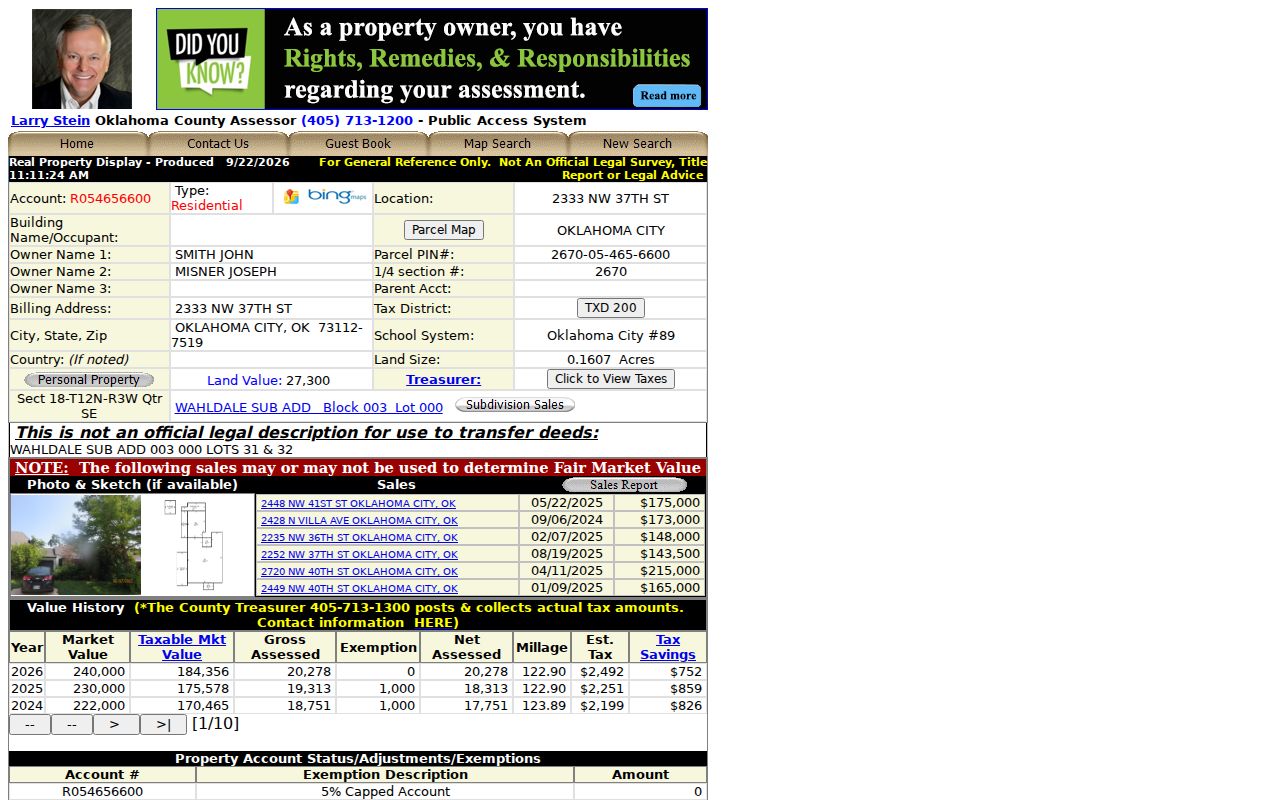
The card warns that its legal-description display is not an official description for transferring a deed. Use a billing address as a search clue, not proof that the owner lives at the property.
- Use the physical location to identify the parcel, then copy its legal description.
- Read deed dates, type, book and page, price, grantor, and grantee as a transfer trail.
- Use the Treasurer for tax payments; assessor value history is not a tax bill.
- Read permits as dated work records, not proof of who lived there.
- If an address returns no result, check the county line and try the map or account fields.
The visible transaction tax-year menu reaches 2000 through 2026, but it does not state when the complete deed history begins. Oklahoma’s county systems differ, so use the correct county’s clerk terminal, phone line, or copy request when online results stop. The address-by-address method belongs on the Oklahoma street directory page.
Note: A tax-year choice on this Oklahoma County screen is not proof that the assessor’s full historic deed coverage begins in 2000.
Oklahoma Court Records for Resident Verification
The Oklahoma State Courts Network (OSCN) searches appellate and participating district or lower courts by case or party. It is an index, not a universal archive of filings. A name match may identify a plaintiff, defendant, lawyer, or another party; it does not show that the person lives in the county now.
The OSCN form uses the fields below. A city citation belongs in that city’s municipal system, and a district Court Clerk remains the route for older files, certified copies, and documents not linked online.
| OSCN field or mode | Type | Required | Options or limits |
|---|---|---|---|
| County or Court | Dropdown | Not stated | Select a participating court. |
| Case Number | Two text inputs | No | Case-number search mode. |
| Last, First, Middle Name | Text | No | Party-name search. |
| Born On or After / Born Before | Date range | No | Optional party filter. |
| Party Type | Dropdown | No | District or lower-court party type. |
| Case Type | Dropdown | No | District or appellate category; options load by interface. |
| Filed / Closed After and Before | Date pairs | No | Limits the case date range. |
| Lower Court and Case Type | Dropdowns | No | Appellate-only lower-court number mode. |
| Filing Year and Number | Text | No | Appellate lower-court case number. |
| Citation Number | Text | No | District traffic search; municipal citations are excluded. |
A public result can show the case number, court and county, case type, filing date, party roles, status, disposition, docket events, and links to available filings. A docket is the dated list of events in a case. Some documents stay with the local clerk; sealed, juvenile, expunged, adoption, and confidential family matters may be absent or redacted.
For a federal case, use PACER. For a city citation, search the municipality that issued it. A court party is one piece of an Oklahoma resident lookup, so compare dates and county before joining it to a parcel or directory entry.
Current Sources in the Oklahoma Residents Directory
Different Oklahoma records put a person in different roles. A title owner, voter, court party, and business officer are not interchangeable. This coverage table separates what each source can confirm from what it cannot establish, so a public hit is not mistaken for a complete household list.
| Source | Who It Can Locate | Keeper | Access and limit |
|---|---|---|---|
| Assessor parcel record | Named owners tied to a parcel | Each county assessor | Portal, phone, or counter; not every occupant |
| Voter verification | A registered voter checking their own record | State Election Board | Name and date of birth; added checks may apply |
| Election Data Warehouse | Approved users accessing election datasets | State Election Board | Full voter-list access is limited by law |
| Court index | Named parties and their case roles | OSCN and local Court Clerk | Public docket is not every file; limits apply |
| Vital event index | Eligible birth or death index entries | OSDH / OK2Explore | Free index; copy access has separate rules |
| Business filing | Entity, agent, or listed officer | Oklahoma Secretary of State | Affiliation evidence, not a home address |
A roll is a list held for a set purpose; an index points to records but may not show the full image. The Oklahoma resident lookup must use a second source when identity matters. Old-volume details appear on the Oklahoma city directory collections page.
Oklahoma Voter Lists and Resident Verification
The OK Voter Portal is for a voter to verify their own registration, address, districts, polling place, or sample ballot. The person enters the name as registered and date of birth; some services ask for extra verification. It is not a public map of every voter along an Oklahoma street.
Full voter-list access changed effective November 1, 2025. The Election Data Warehouse separates full and basic requests. Full access is limited to qualified Oklahoma residents and other categories named in 26 O.S. §7-103.2; basic access does not include the registration list. Approved files arrive as CSV and refresh each weeknight. The Board says phone numbers and email addresses are not registration fields, and Social Security and driver-license numbers are not released. The EDW access page gives the current request routes.
Protected and Address Confidentiality Program addresses are withheld. The file does not show ballot choices, and a registration record is not proof that every member of a household lives at that address. For routine self-checks, use the individual portal; for records, follow the Board’s application and eligibility rules.
Note: A restricted address may be absent by design, so do not use nearby records to infer a protected voter’s location.
Oklahoma Vital Records for a Resident Search
OK2Explore is a free index for birth and death events, searchable by event type, date, county, name, and sex. It can show whether an entry is on file, but a hit is not the certificate. Oklahoma began filing births and deaths in October 1908; filing became mandatory in 1917, and routine state filing did not become common until the 1940s.
The index includes births at least 20 years old and deaths at least 5 years old. Under 63 O.S. §1-323, copies become open at 125 years for birth records and 50 years for death records. A newer closed record requires an eligible applicant or another statutory route. The stated search fee is $15 per record, with $15 for each extra copy; photo ID, application, payment, and proof of eligibility may be required. The OSDH vital-record rules explain the distinction between the index and a copy.
For a birth-parent search, an index hit does not unseal an adoption record. OSDH requires a certified court order for sealed adoption birth records. Marriage records go to the county clerk where the license was issued; divorce case files stay with the district Court Clerk, while OHS lists some historical indexes.
Note: The free index search and a paid certificate order are separate steps with separate access rules.
Match an Oklahoma Resident With Two Facts
One Oklahoma name can appear in a deed, a court case, a voter file, and a directory without all four records describing the same person. Keep a short dated note of the name as printed, county, spouse or middle initial, address, and record type. A matching name alone is not enough to join records.
Look for two independent details that fit together. An assessor card can match a parcel and legal description, while a directory or census places a household at an address in a different year. A court docket gives a party and case date, not current residence. A business filing or professional license is evidence of a public affiliation, not proof of where its officer lives.
- Parcel
- A tract or lot identified in county property records.
- Situs address
- The physical location attached to a parcel, distinct from its billing address.
- Legal description
- Lot, block, or section language that identifies land for a deed.
- Docket
- The dated list of events in a court case.
If the facts do not line up, keep the results separate. Ask the clerk which record the entry describes, or check a second date and county before drawing a conclusion about an Oklahoma resident.
Municipal Records for Oklahoma Residents
Oklahoma has no statewide municipal-record portal. The city clerk is the first route for meeting files, licenses, cemetery records, and city requests. Municipal citations are separate from OSCN, so search the court serving the city shown on the address. Building and code files can be keyed by street number, but online search fields, dates, and fees differ by city.
Use the city’s own records page or clerk counter, then call the department that made the record if the online search is blank. Ask for an address search in writing when needed, and give the street direction and suffix as they appear on the parcel. A local library can fill gaps with city directories, newspaper microfilm, yearbooks, and cemetery indexes; Oklahoma has more than 200 public libraries across eight systems, but each branch’s holdings differ.
A permit dates work or an application, not the person who lived in a building. A cemetery lot entry can name an owner or burial, not a current household. Keep each Oklahoma municipal record tied to the agency and date that produced it.
Note: City court portals and request fees vary, so check the municipality that actually issued the record.
Requesting Oklahoma Records With Enough Detail
The Oklahoma Open Records Act, 51 O.S. §§24A.1–24A.31, covers existing identifiable records. A custodian does not have to create a new custom report or reorganize data that is not already kept. Give the office a record type, a reasonable date range, an address or name where useful, and a clear set of search terms. Send the request to the agency that created or holds the record.
The State Election Board’s request information shows the form, email route, and one agency’s fee schedule. The Board accepts forms at recordsrequest@elections.ok.gov. Its examples include 25 cents per ordinary page, $1 for a certified or notarized page, $10 for an audio recording, and hourly charges for programming or extensive searches. An estimate above $75 may require advance payment under that schedule. These are the Board’s examples, not a universal price list for Oklahoma offices.
The official request page shows where an email submission and fee notice fit into the process:
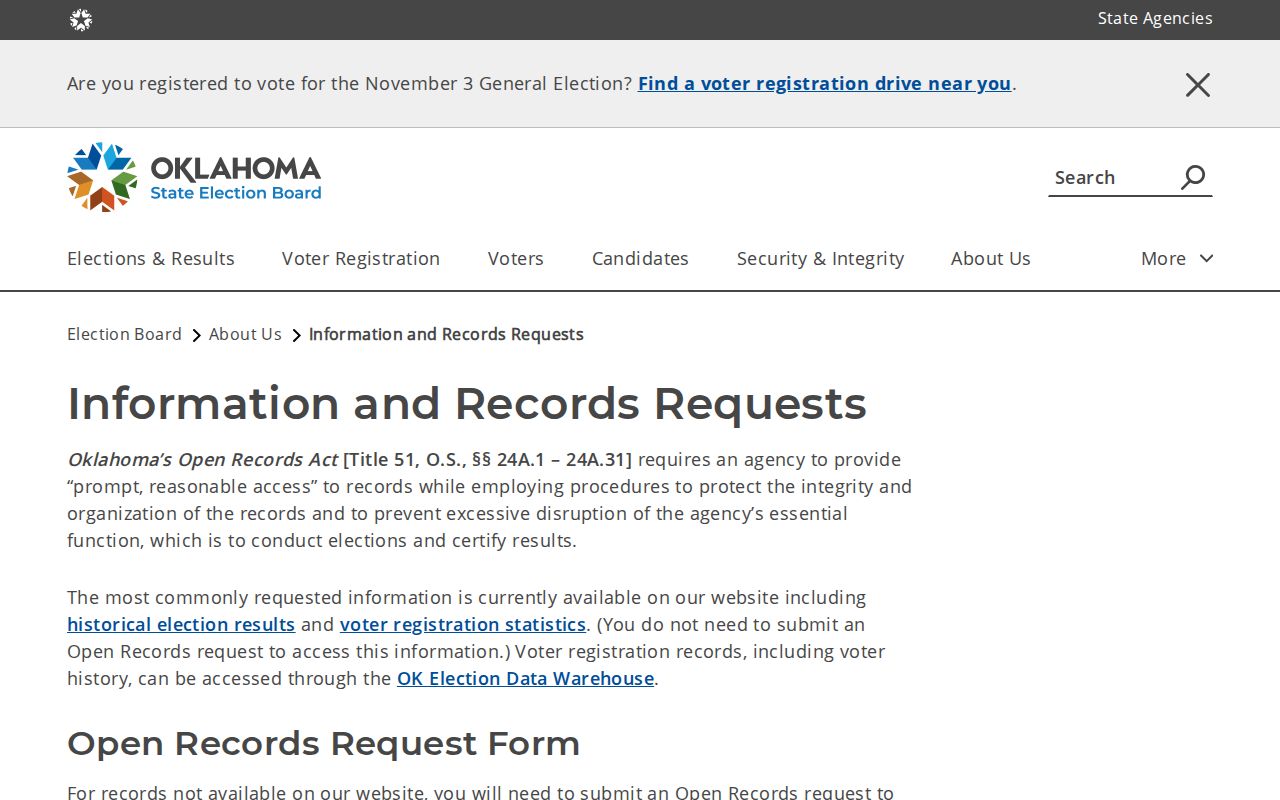
Ask for a fee estimate and delivery method before a larger request proceeds. If a portal has no image, the right fallback may be a phone call, public terminal, mailed copy request, or a library/archive search rather than a broader request to the wrong county.
What Oklahoma Resident Records Leave Out
Oklahoma’s public sources leave real gaps. Parcel cards do not list each renter or household member. Court indexes can omit sealed, juvenile, or expunged material. Vital records have age and eligibility rules. Utilities, delivery files, and private association rosters are not general public lists. An absent entry may reflect a lawful limit or a different keeper, not a bad search.
Commercial profile compilers gather public and purchased material, may merge people with similar names, and can retain an old address. An opt-out request to a private compiler does not correct a county deed, voter record, court docket, or vital record. Use a source office for corrections, and keep research to a lawful personal purpose.
Official record
Names the keeper, record date, fields, and access rule. A clerk can explain how to request a copy or correct its source.
Commercial profile
May combine sources and present a stale or mixed result. A private opt-out does not change the original public record.
Voter address protections include 26 O.S. §4-115.2, and the Address Confidentiality Program is established under 22 O.S. §60.14. Oklahoma’s anti-stalking law is 21 O.S. §1173. A directory result should not be used to bypass a privacy safeguard or to harass another person.
Oklahoma Historical Resident Directories
Oklahoma’s early printed resident lists include Smith’s First Directory of Oklahoma Territory for 1890–91, Guthrie and Logan County volumes dated 1892 and 1898, Garfield County in 1896, Woods County in 1895, and Oklahoma City and County in 1900–1901. These books cover different places and purposes; they are examples, not a complete statewide annual run. The Oklahoma Historical Society directory search accepts a city or year, while the books themselves are accessed at its Oklahoma City Research Center.
OHS also lists phone books, yearbooks, cemetery books, probate, obituaries, tribal records, and subscription genealogy resources. Ask the reference desk about reverse or criss-cross volumes, microfilm, and local holdings. The historic collection’s coverage and reading method are explained on the Oklahoma city directory collections page.
A directory can show a name and address in one year, but it is not a certified residence record. Compare its entry with a census, deed, or newspaper, and check the volume’s own abbreviation key before reading occupation, spouse, or owner marks as facts.
Note: OHS’s early volumes are examples; use the city and year search to confirm a particular run.
Oklahoma Land Records Begin Before Statehood
Statehood joined Oklahoma and Indian Territories on November 16, 1907, but land and resident records did not begin under one county system. In Indian Territory, land was held by tribal nations before Dawes allotment began in 1902. Oklahoma Territory land ownership followed the 1889 opening and later openings through 1906. A resident’s earliest trail may sit in a tribal or federal file, a tract book, a townsite record, or a territorial directory.
The Oklahoma Historical Society reports that many Indian Territory recording-district books were not preserved by the new counties, so many county land series begin in November 1907. An apparent deed gap may be historical, not a failed name search. Its land-records guide describes 72 Federal Tract Book volumes arranged by township and range, while Smith’s 1890–91 directory is an unusually broad early locator.
For a parcel, use the legal description and county map to route the search. For an older household, pair the land trail with a directory, census, or newspaper, and ask an archive or local library about the series that fits the town and period.
Note: Oklahoma County examples do not set online coverage or copy-fee rules for another county.